SPD / AC SPD
AC 4P SPD
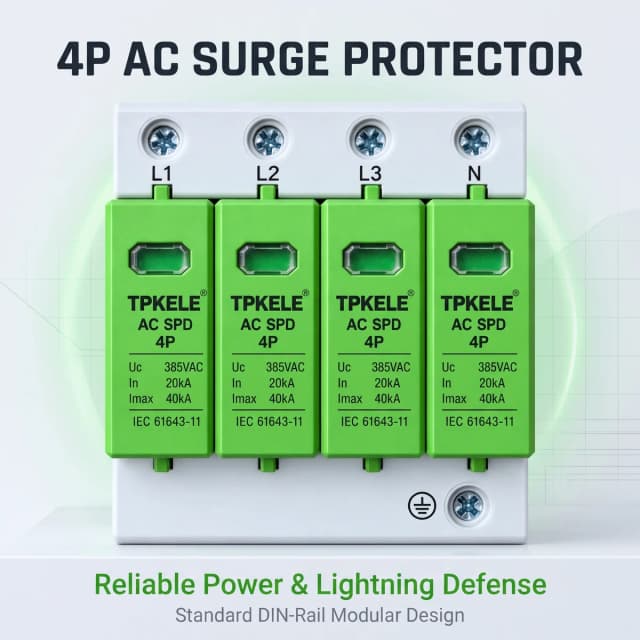
TPKELE AC 4P SPD is a four-pole surge protective device engineered for three-phase + neutral AC distribution systems. Designed for commercial buildings, industrial facilities, and inverter AC outputs, it delivers Type 2 surge protection across all four conductors (L1, L2, L3, N) with independent pluggable cartridges for each pole. The modular design enables selective cartridge replacement without system downtime, while quadruple visual status windows provide instant operational feedback for each phase and neutral. Clear terminal labeling (L1, L2, L3, N) simplifies installation and reduces wiring errors in busy panel builds. Ideal for three-phase distribution boards, inverter outputs, telecom base stations, and any AC system requiring comprehensive multi-pole surge defense.
Key Features
- 4-pole (L1, L2, L3, N) configuration for three-phase + neutral systems
- Uc 385V AC — covers standard 400V three-phase networks
- In 20kA / Imax 40kA (8/20μs) — Type 2 protection level
- Independent pluggable cartridges per pole for selective replacement
- Quadruple visual status indicators (green = OK, red = replace)
Need full datasheet, drawing or certificates for tender?
Typical Applications
Technical Specifications
| Product Type | 4-Pole AC Surge Protective Device (Type 2) |
|---|---|
| Model | AC 4P SPD |
| Pole Configuration | 4P (L1, L2, L3, N) |
| Max. Continuous Operating Voltage (Uc) | 385V AC |
| Nominal Discharge Current (In) | 20kA (8/20μs) |
| Max. Discharge Current (Imax) | 40kA (8/20μs) |
| Voltage Protection Level (Up) | ≤1.5kV |
| Response Time | <25ns |
| Protection Type | Type 2 (IEC 61643-11) |
| Status Indication | Quadruple visual window per pole (Green = Normal / Red = Fault) |
| Cartridge Type | Pluggable per pole, tool-free replacement |
| Remote Signaling | Optional NC/NO contact output |
| Mounting | 35mm DIN rail (IEC/EN 60715) |
| Width | 72mm (4 modules) |
| Connection | Screw terminal, 6–25mm² cable capacity |
| Torque | 2.5 N·m |
| Protection Degree | IP20 (when mounted) |
| Operating Temperature | −40°C to +85°C |
| Housing Material | Flame-retardant thermoplastic, UL94 V-0 |
| Standards Compliance | IEC 61643-11, EN 61643-11 |
| Certifications | CE, RoHS |
| Applications | Three-phase distribution boards, inverter AC outputs, commercial buildings, industrial facilities, telecom base stations |
Certifications & Standards
Verified to international standards for global tenders
OEM / ODM Available
Private label this SPD for your brand
Logo, color housing, packaging and certificate documentation tailored to distributor and brand-owner programs.
- Custom logo printing on housing and packaging
- Color housing variants for product line differentiation
- Private-label catalogs and datasheet customization
- Project-spec drawings, single-line diagrams and labels
- Container-load supply with export documentation
- Sample preparation within 5–10 working days
Frequently Asked Questions
Which SPD type do I need for a solar PV project?
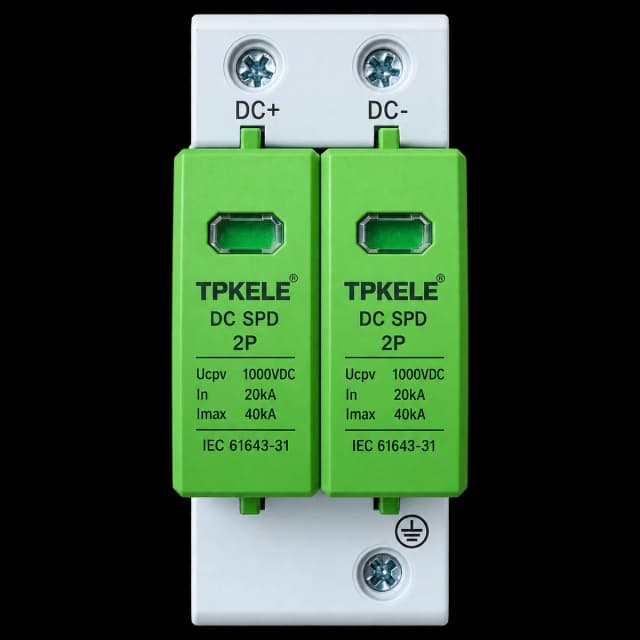
PV strings, combiner boxes and inverter DC inputs require DC SPDs sized to the system Uoc (600V / 1000V / 1500V). Inverter AC outputs and the building distribution board use AC SPDs (Type 2 standard, Type 1+2 if direct lightning exposure is possible).
What is the difference between Type 1, Type 2 and Type 1+2?
Type 1 (10/350μs waveform) protects against direct lightning strike currents at the building entrance. Type 2 (8/20μs) protects against induced surges downstream. Type 1+2 combines both — used at the main distribution board when a lightning protection system is present.
What does Imax / In mean on an SPD?
In = nominal discharge current (8/20μs) the SPD can pass repeatedly. Imax = maximum one-shot discharge current the SPD can handle once and remain functional. Choose In/Imax based on lightning exposure and project specs.
Are TPKELE SPDs CE certified?
Yes — all SPDs comply with CE, RoHS and IEC 61643-11 (AC) / IEC 61643-31 (DC PV). Test reports are available for project files and tenders.
Do you offer SPDs with remote signaling output?
Yes, selected models include a remote signaling contact (NO/NC) so you can monitor SPD health from a central control system or BMS.