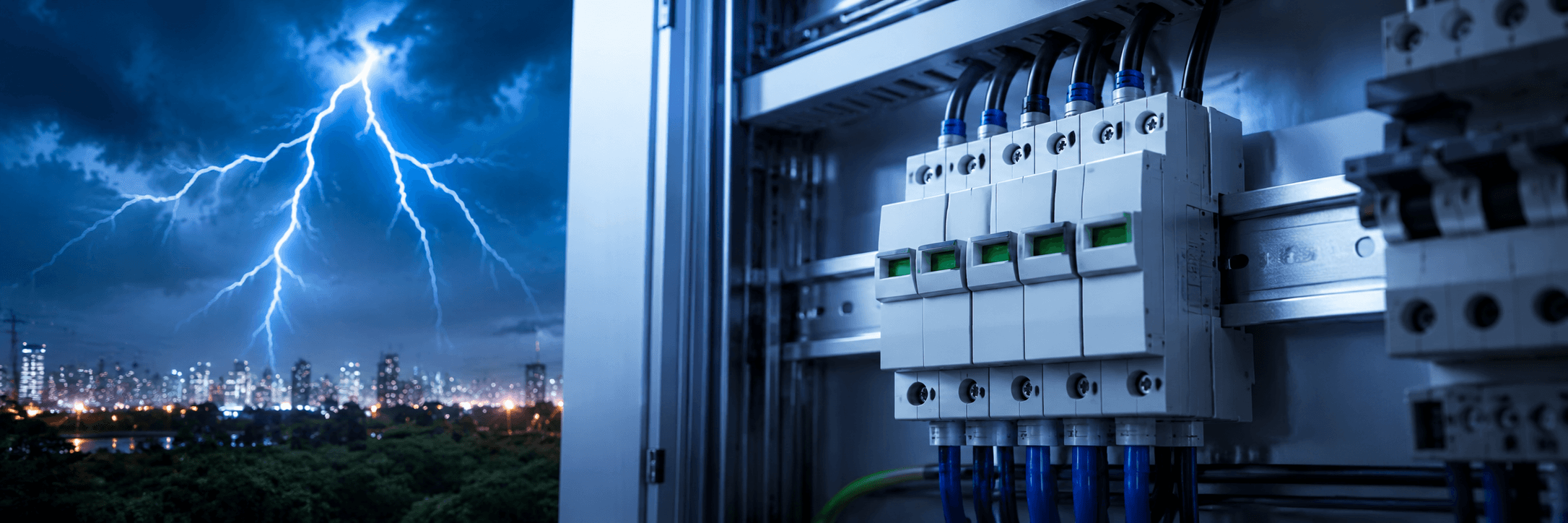
What Is a Surge?
A surge — also called transient overvoltage — is a brief, high-amplitude voltage spike that can damage electronic equipment in milliseconds. The two main causes are direct or nearby lightning strikes and switching events on the utility grid (capacitor banks, large motor starts, fault clearing).
A surge protective device (SPD) clamps the overvoltage to a safe level by diverting the surge current to ground, protecting downstream equipment such as PV inverters, control systems and telecom gear.
Type 1, Type 2, and Type 1+2 Explained
- Type 1 — installed at the service entrance to handle direct lightning current (10/350µs waveform). Required where there is an external lightning protection system.
- Type 2 — installed in distribution panels to clamp residual surges and switching transients (8/20µs waveform). The most common SPD class.
- Type 1+2 — combined unit for projects that need both direct-strike capability and downstream clamping in a single device.
Where to Install SPDs
Best practice is a coordinated cascade: a Type 1 (or 1+2) at the main panel, Type 2 in sub-panels, and finer protection close to sensitive equipment. In a solar PV system, install DC SPDs in the combiner box and at the inverter DC input, plus AC SPDs on the inverter AC output and at the grid interconnect.
Keep SPD lead lengths short (typically under 50 cm total loop length) — long leads add inductance that defeats the protection.
AC SPD vs DC SPD
AC SPDs are sized by Uc (maximum continuous operating voltage) — typical values are 275V for 230V AC systems and 385–440V for 400V AC three-phase. DC SPDs are sized for the maximum PV string voltage at the coldest expected temperature: 600V, 1000V or 1500V Uoc options cover most installations.
DC arcs do not self-extinguish, so a DC SPD must include disconnection technology that isolates a failed varistor without sustaining an arc.
Key Specs to Compare
- Type (1 / 2 / 1+2) — matches install location and lightning risk.
- Uc / Uoc — must exceed the system's maximum continuous voltage.
- In (nominal discharge current) — typically 20 kA for Type 2.
- Imax (maximum discharge current) — repeated 8/20µs withstand.
- Up (voltage protection level) — clamping voltage seen by the load; lower is better.
- Indicator window — visual end-of-life status.
- Certification — IEC 61643-11 (AC) / IEC 61643-31 (DC).
Frequently Asked Questions
- Do I need an SPD if I have a lightning rod?
- Yes. A lightning rod handles direct strikes to the structure, but coupled surges still propagate on the power lines. SPDs clamp those induced overvoltages before they reach equipment.
- How often should SPDs be replaced?
- An SPD with an indicator window should be inspected during every electrical maintenance visit. Replace immediately if the indicator shows red or the unit has been exposed to a major surge event.