Why PV Systems Need a Combiner Box
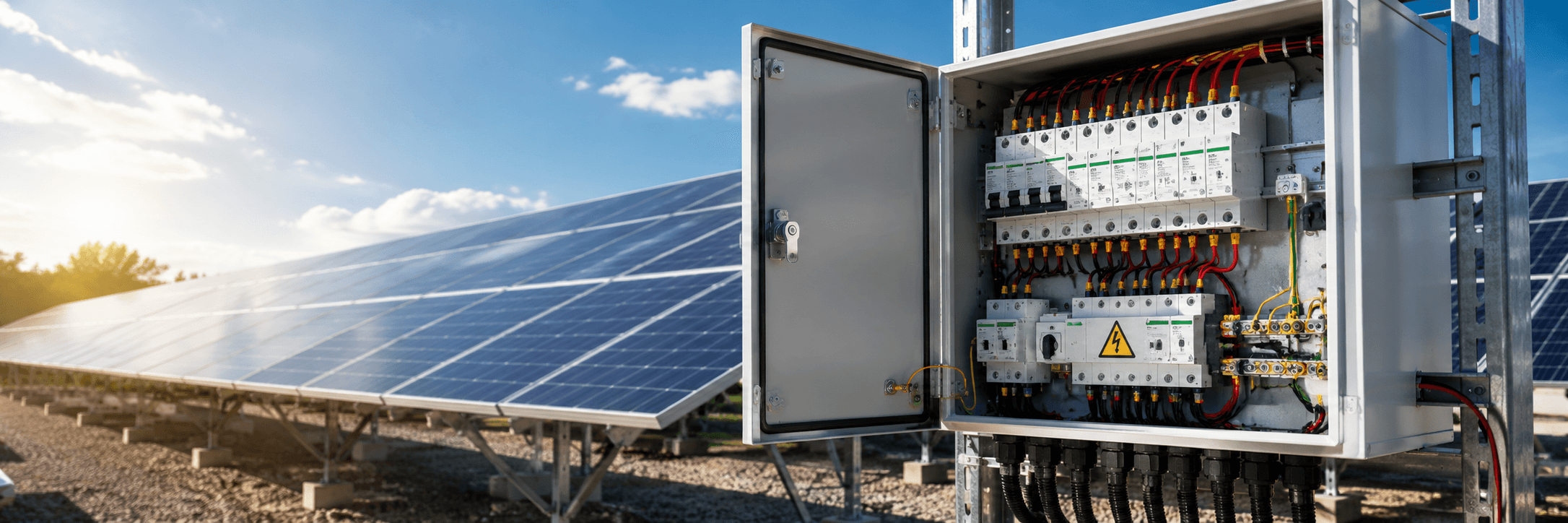
A PV combiner box consolidates multiple solar string outputs into a single DC trunk that feeds the inverter. Beyond simplifying field wiring, the combiner box concentrates protection — fuses, breakers, disconnects and surge protection — at one accessible point.
On utility-scale farms, combiner boxes also provide string-level monitoring data so operators can detect a single underperforming string out of dozens without sending a technician up the field.
What's Inside a TPKELE Combiner Box
- DC fuses or DC MCBs on every string for overcurrent protection.
- DC SPD (Type 1+2 or Type 2) for lightning and switching surges.
- Lockable DC isolator for safe maintenance disconnection.
- Surge-suppressed monitoring outputs (optional, on smart boxes).
- IP65 enclosure for outdoor mounting.
Choosing String Count, IP Rating and Voltage Class
Pick the string count that matches your array layout — TPKELE offers boxes for 2 to 16 string inputs. IP65 is standard for ground-mount and rooftop installations; IP66 is preferred for marine and dusty industrial environments.
The voltage class must match the system's open-circuit voltage at the coldest temperature: 1000V Uoc for residential and many commercial installations, 1500V Uoc for utility-scale arrays where higher voltage reduces conductor losses.
Plastic vs Metal Enclosures
Plastic (ABS) combiner boxes are corrosion-immune, light, easy to drill in the field, and the right choice for coastal and humid sites. Metal enclosures provide better mechanical protection on industrial sites and on poles where impact and vandalism are concerns.
Common Specifications
- Residential rooftop — 2 to 4 strings, plastic, 1000V Uoc.
- Commercial / C&I — 4 to 8 strings, plastic or metal, 1000V or 1500V.
- Utility-scale — 8 to 16 strings, metal, 1500V, with monitoring.