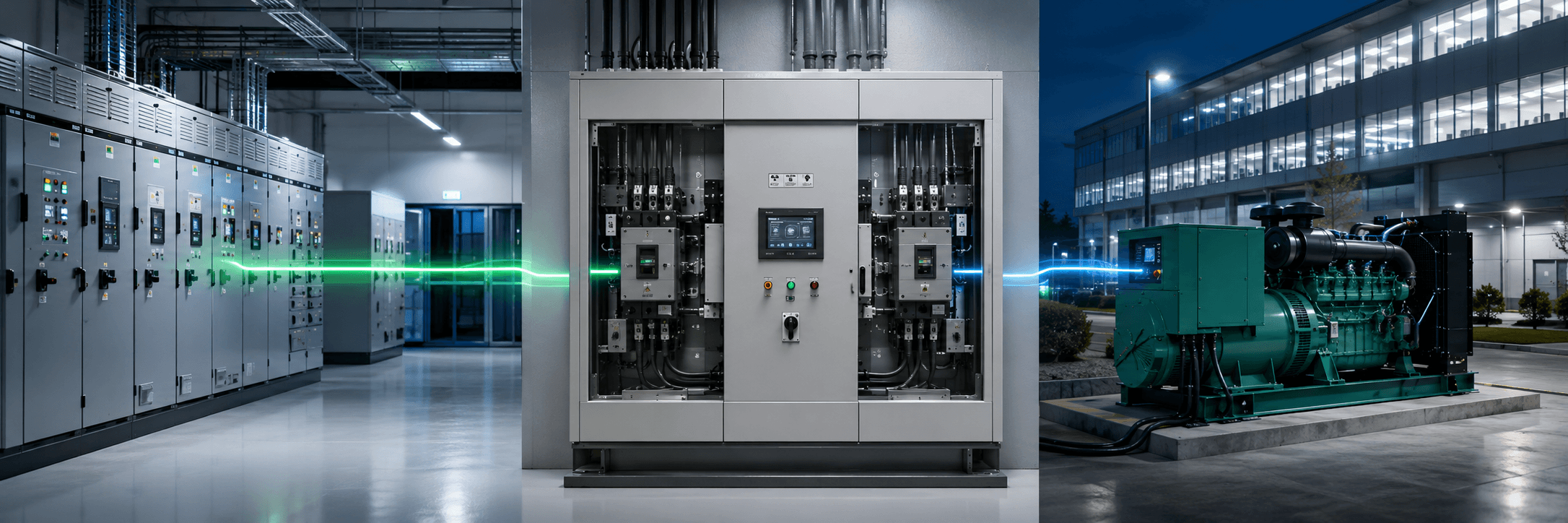
What an ATS Does
An automatic transfer switch (ATS) monitors the primary utility supply and, when it falls outside acceptable limits, transfers connected loads to a secondary source — usually a generator or alternate utility feed — within milliseconds. When utility power returns, the ATS retransfers loads back automatically.
Without an ATS, transfer between sources is manual and slow, which is unacceptable for hospitals, data centers and any facility with continuity-critical loads.
Common Applications
- Hospitals and clinics — life-safety circuits, OR/ICU equipment.
- Data centers and telecom — server, cooling and BMS continuity.
- Industrial process plants — avoid product loss from interrupted batches.
- Commercial buildings — fire pumps, elevators, emergency lighting.
- Rural and off-grid sites — utility plus diesel generator handover.
Specifying an ATS
The four core parameters: pole count (2P / 3P / 4P depending on neutral switching needs), rated current (TPKELE ATS units are rated 63A for branch and small-main applications), rated voltage (110V or 220V AC), and transfer time (PC-class units transfer in ~50ms; CB-class motorized units in ~2s).
Mechanical and electrical life ratings tell you how many transfer cycles the unit will survive — important for facilities that test their backup weekly.
ATS vs Manual Transfer Switch
Manual transfer switches are cheaper and simpler but require an operator to physically move the handle when utility fails. They make sense for sites where downtime is tolerable. For anything with safety, financial or continuity stakes, an ATS pays for itself the first time it operates without human intervention at 3 a.m.
Sizing Tips for Generator Backup
- Confirm the generator's continuous output rating exceeds the connected load with margin (typically 1.25x).
- Match the ATS rated current to the generator output, not the utility feed.
- If the generator is downstream of a step-down transformer, account for inrush during retransfer.
- Coordinate ATS settings with generator warm-up and cool-down times to avoid premature retransfer.