Why the Type 1 vs Type 2 Distinction Matters
An SPD cannot be selected by comparing discharge-current figures alone. The first question is which standard and installation position the specification addresses: IEC 61643-11 classifies AC SPDs by test class, while UL 1449 uses Type designations tied to installation conditions. Treating these labels as interchangeable can lead to a device being specified for the wrong duty or location.
For an IEC-based specification, identify the required test class, impulse or nominal discharge-current rating, voltage protection level and intended position in the installation. For a UL-based project, confirm the required UL 1449 Type, installation location and applicable voltage and short-circuit ratings. In either case, confirm the published ratings and approvals for the specific model before placing it on a bill of materials.
How Type 1 and Type 2 SPDs Are Tested
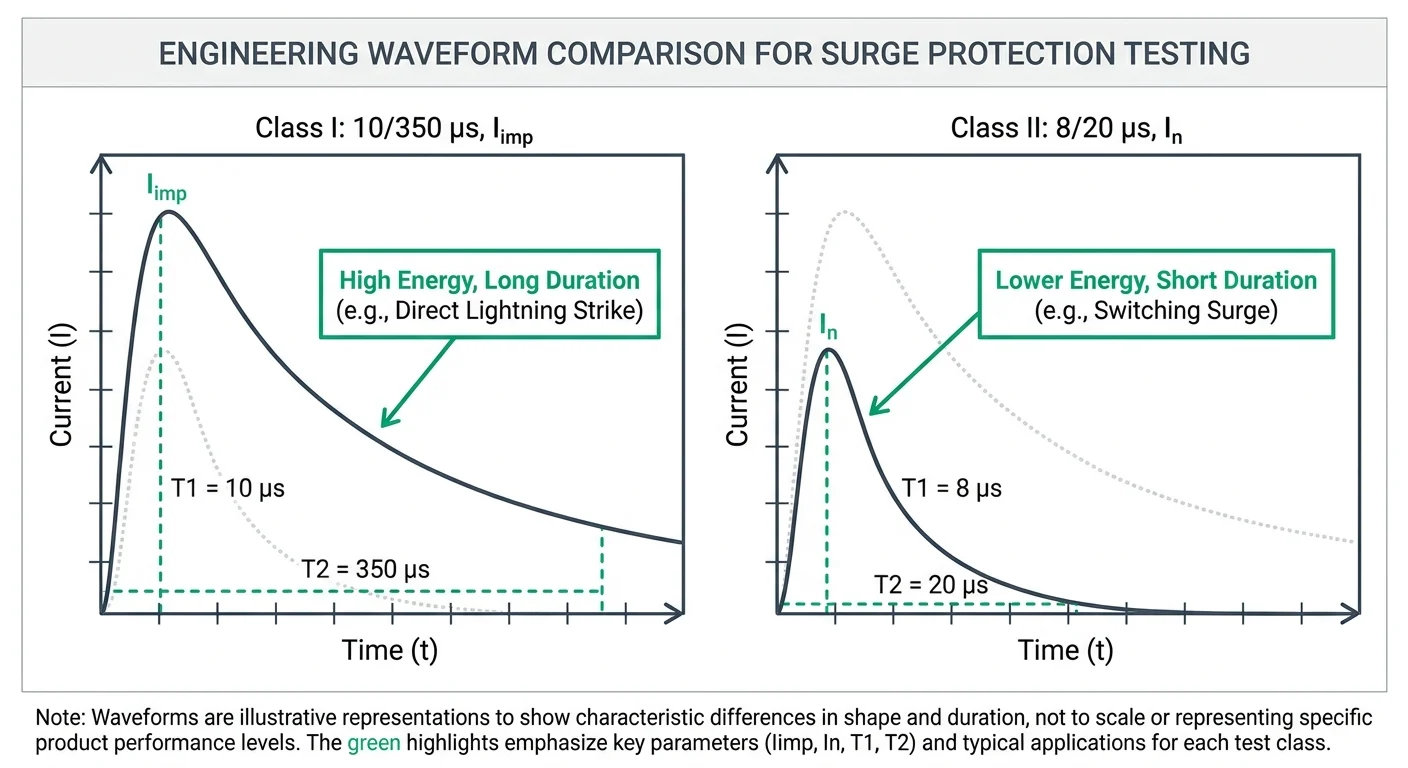
IEC 61643-11 distinguishes Type 1 and Type 2 AC SPDs through different test classes and impulse waveforms. The Class I test uses a 10/350 µs current impulse, while the Class II test uses an 8/20 µs current impulse. Because these waveforms differ substantially in duration and energy, their stated current values cannot be compared as interchangeable performance rankings.
| Test characteristic | Type 1 SPD | Type 2 SPD |
|---|---|---|
| IEC 61643-11 test classification | Class I | Class II |
| Current impulse waveform | 10/350 µs | 8/20 µs |
| Relevant declared current | Impulse discharge current, Iimp | Nominal discharge current, In |
| What the test evaluates | Performance under the specified Class I impulse test conditions | Performance under the specified Class II impulse test conditions |
Where Each SPD Fits in an AC Installation
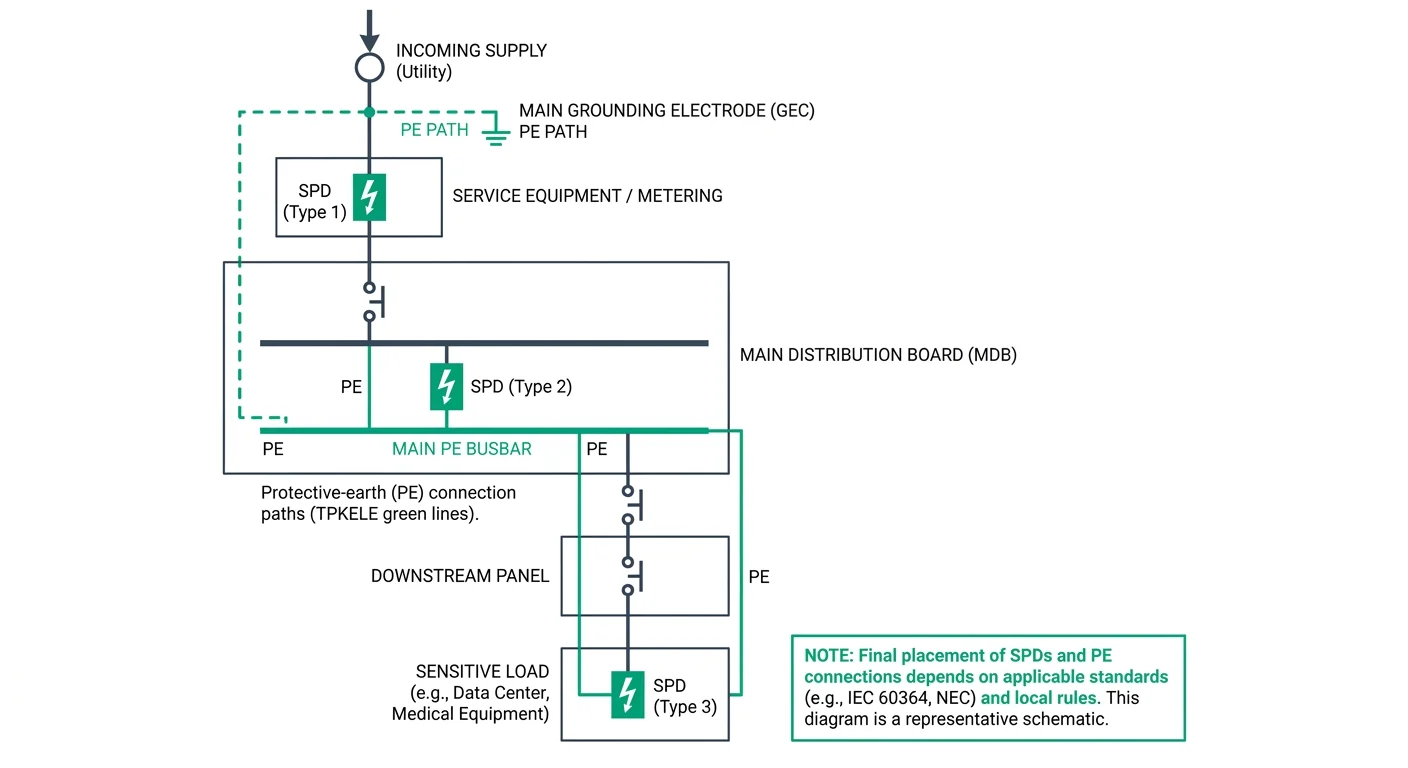
SPD location should be selected from the installation’s exposure, earthing arrangement, incoming supply, and required protection zone—not from the device label alone. A Type 1 SPD is generally considered at the service entrance or main distribution point where part of the lightning current may enter the installation, particularly where an external lightning protection system or overhead supply increases exposure. A Type 2 SPD is normally installed downstream in a main or sub-distribution board to limit switching and residual surge voltages after the service-entry stage.
Exposure assessment should consider overhead or underground supply, lightning protection on the building, local lightning activity, building-to-building cable routes, the length of downstream circuits, and the sensitivity or service continuity requirements of connected equipment. For projects designed to IEC practices, the selection and installation should be checked against IEC 61643-11 and the relevant requirements of IEC 60364-5-53; European, US, Australian, and New Zealand installations may require additional national provisions. The final quotation should state the installation position, system configuration, Uc, protection level, discharge or impulse current rating, backup protection, and coordination method, with values confirmed for the specific model.
Ratings to Check Before Specifying a Model
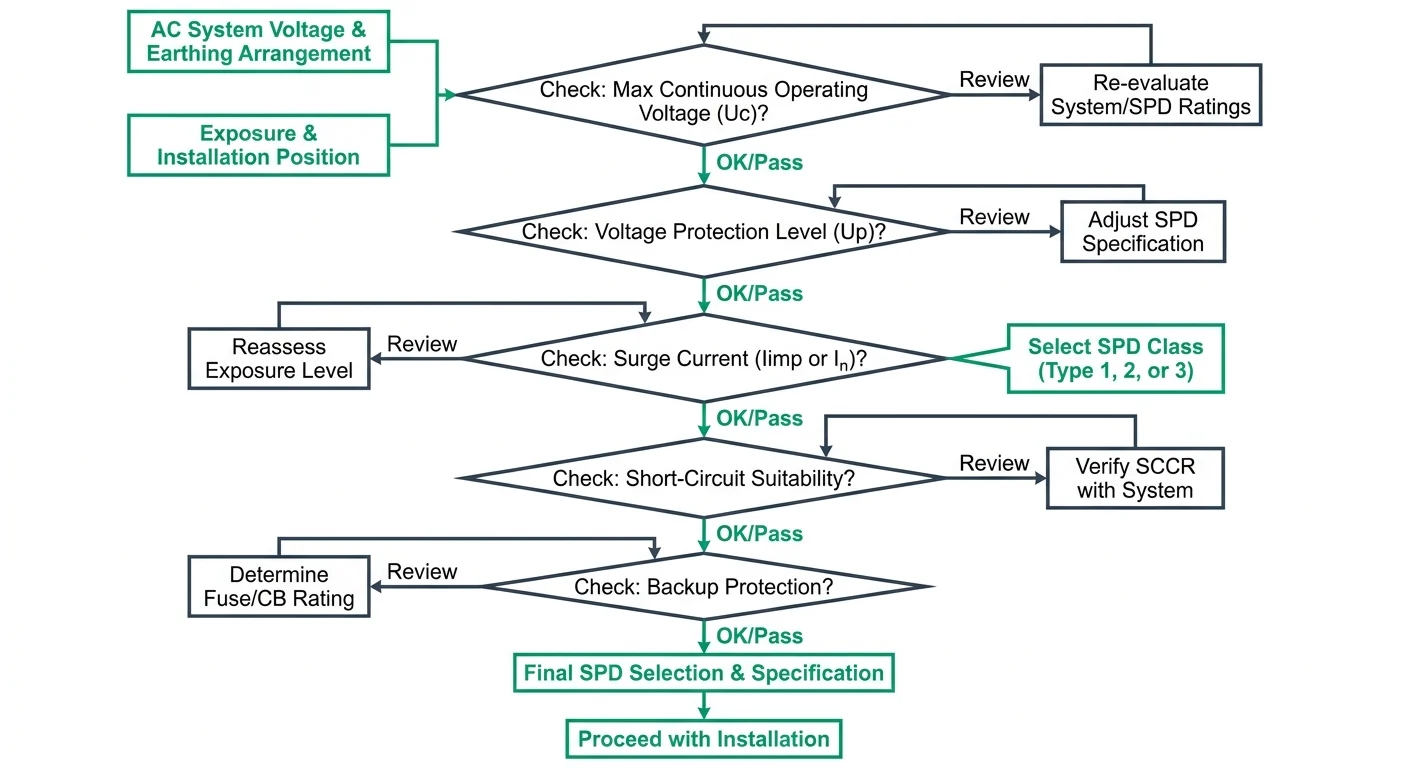
Compare the ratings against the installation’s nominal voltage, earthing arrangement and prospective fault conditions. Confirm the applicable SPD product standard and the exact rating definitions on the manufacturer’s datasheet; similar-looking values may use different test waveforms or measurement conventions. The figures below are selection checks, not a substitute for model-specific coordination and installation instructions.
Selection Examples for AC Panels and PV Systems
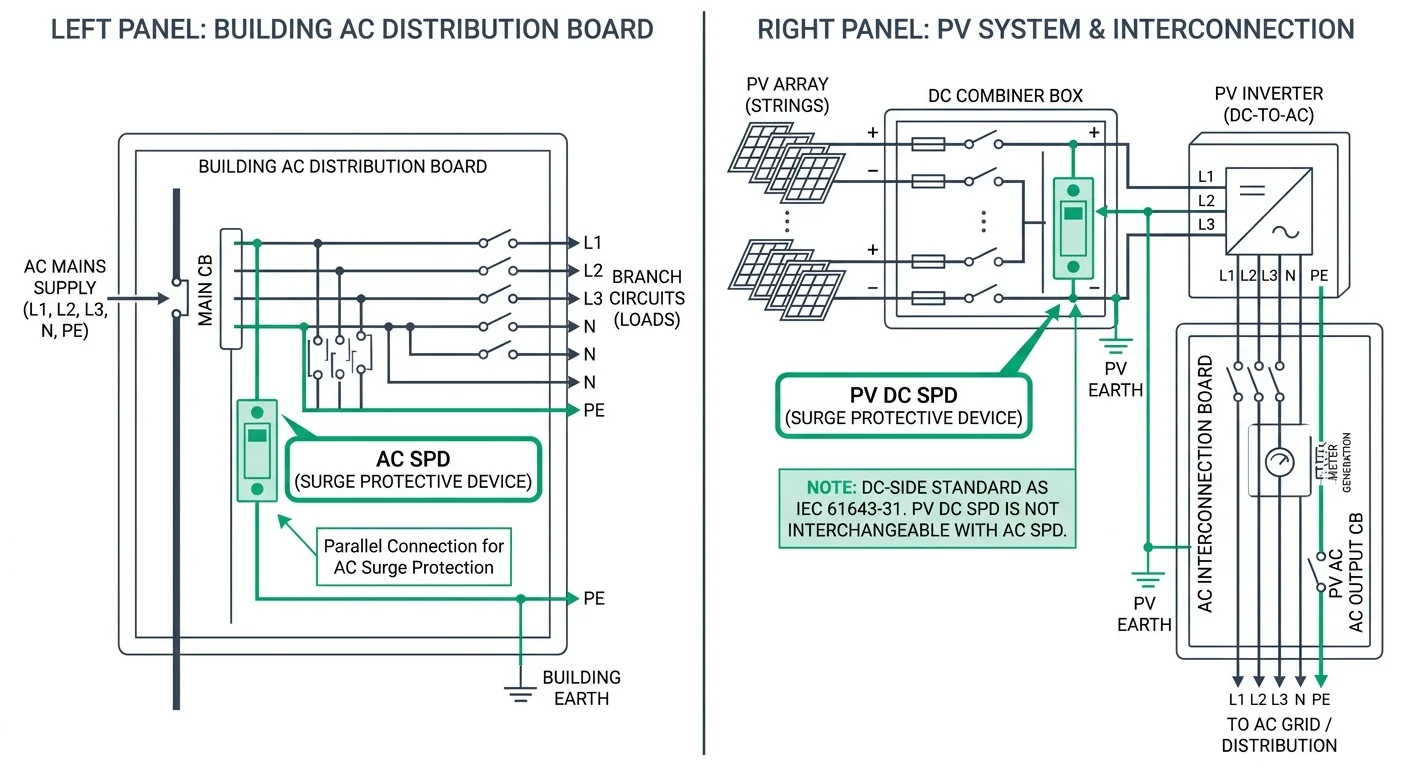
For a building AC distribution board, select the SPD for the supply system, the board’s installation position and the applicable installation standard. A Type 2 SPD is commonly specified at a distribution board where the installation assessment calls for protection against induced surges; a Type 1 or combined Type 1+2 device may be required where the assessed lightning-current risk and installation arrangement call for it. Confirm the required voltage protection level (Up), maximum continuous operating voltage (Uc), short-circuit withstand and backup protection with the specific device data and project requirements.
| Application point | Selection focus | Specification notes |
|---|---|---|
| Building AC distribution board | AC system voltage and earthing arrangement; Type 1, Type 2 or Type 1+2 classification as required by the installation assessment | State the installation position, required Uc and Up, short-circuit conditions, and any required backup overcurrent protection. Confirm coordination with upstream and downstream protective devices. |
| PV inverter AC connection | AC supply characteristics at the inverter connection and the protection required for that installation point | Specify an AC SPD for the AC system and its earthing arrangement. Select its type and ratings from the site assessment and applicable installation requirements; do not infer the required type from the inverter alone. |
| PV array DC circuit | PV DC voltage and current conditions, array configuration, inverter limits, and exposure at the DC installation point | Specify separately for the DC application. Confirm the SPD's DC operating voltage and ratings, polarity and circuit arrangement, and compatibility with the PV system and inverter using model-specific documentation. |
Documentation and Questions for Suppliers
Request documents for the exact SPD model, pole configuration and voltage variant proposed for the project. A product-family brochure alone does not establish the ratings, test classification or installation requirements of a specific variant. Ask the supplier to identify the applicable standard and the market for which each test report or listing applies.
- Does the evidence identify the exact order code being quoted, including any replaceable module?
- Are the wiring diagram and installation instructions applicable to the project's supply voltage and earthing arrangement?
- Which protective device, if any, does the manufacturer require upstream of this specific SPD model?
Review TPKELE SPD Options and Request a Quote
Review the documented AC SPD models at TPKELE AC SPDs before requesting a quotation. Include the system voltage, earthing arrangement and intended installation position in your inquiry. Specify the required SPD type, maximum continuous operating voltage (Uc), voltage protection level (Up) and applicable discharge-current rating; confirm availability and values against the specific model documentation.
AC SPD selection
Compare AC SPD Models
Check model-specific ratings, then request a quote with your electrical system details and required protection ratings.