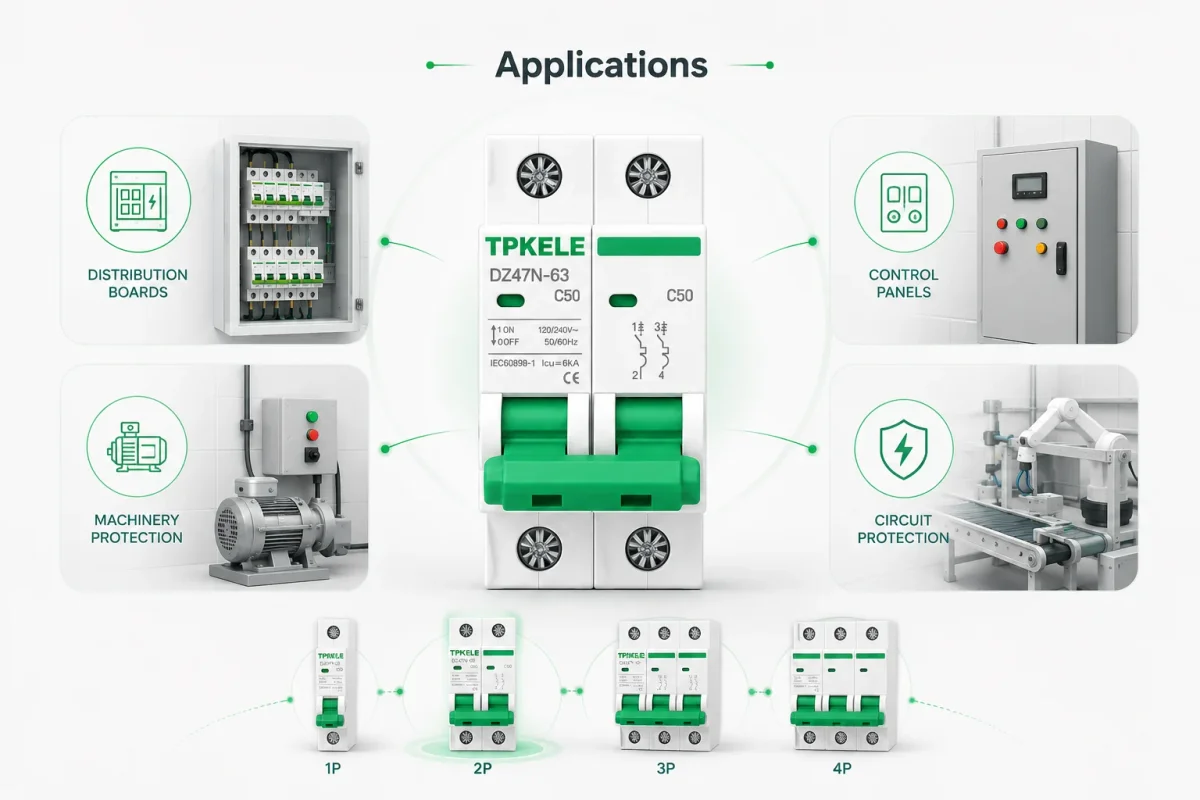
Overview
How to Choose a DC MCB for Solar PV and Battery Storage Systems Learn how to select the right DC miniature circuit breaker by rated current, DC voltage, pole configuration, breaking capacity, trip curve, installation requirements and safety standards.
Introduction
A DC miniature circuit breaker, also known as a DC MCB, is an important protection device used in solar PV systems, battery energy storage systems, DC distribution boards, EV charging equipment and industrial control cabinets.
Unlike AC circuits, DC circuits do not have a natural zero-crossing point. This makes DC arc interruption more difficult and requires a circuit breaker with a dedicated DC arc-quenching structure. For this reason, selecting a DC circuit breaker is not only about choosing the right current rating. You also need to check the DC voltage, number of poles, breaking capacity, trip curve, wiring polarity, installation method and applicable standards.
This guide explains the key technical parameters you should consider when choosing a DC MCB for photovoltaic and battery storage applications.
---
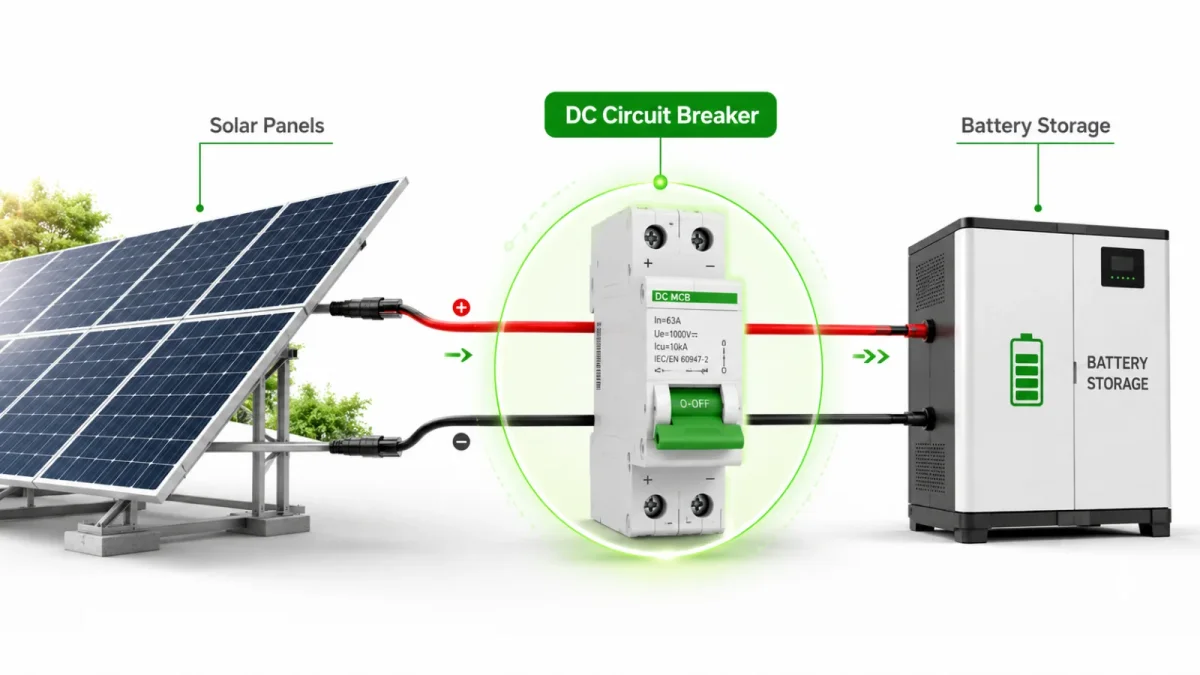
1. Core Electrical Parameters
The first step in selecting a DC miniature circuit breaker is to confirm the basic electrical ratings. These parameters determine whether the breaker can safely operate in the actual DC circuit.
| Parameter | Meaning | Common Range |
|---|---|---|
| Rated Current / In | The current that the breaker can carry continuously under normal operating conditions. | 1A, 2A, 6A, 10A, 16A, 20A, 32A, 40A, 63A, 80A, 100A, 125A |
| Rated Voltage / Ue | The DC voltage that the breaker can safely switch and interrupt. | DC 250V, 500V, 800V, 1000V, 1200V, 1500V |
| Poles | The number of breaker modules or poles. | 1P, 2P, 3P, 4P |
| Breaking Capacity / Icu / Icn | The maximum short-circuit current that the breaker can safely interrupt. | 4.5kA, 6kA, 10kA, 15kA, 20kA |
| Trip Curve | The instantaneous trip current multiple. | B Curve, C Curve, D Curve |
| Rated Insulation Voltage / Ui | The insulation withstand capability of the breaker. | 500V, 1000V, 1500V |
| Rated Impulse Withstand Voltage / Uimp | The ability to withstand lightning impulse or surge voltage. | 4kV, 6kV, 8kV |
| Frequency | DC products generally do not involve frequency. | DC |
When comparing different DC MCBs, always check the rated voltage and breaking capacity together. A breaker with the correct current rating but insufficient DC voltage or short-circuit capacity may not provide safe protection.
---
2. Overload and Short Circuit Protection
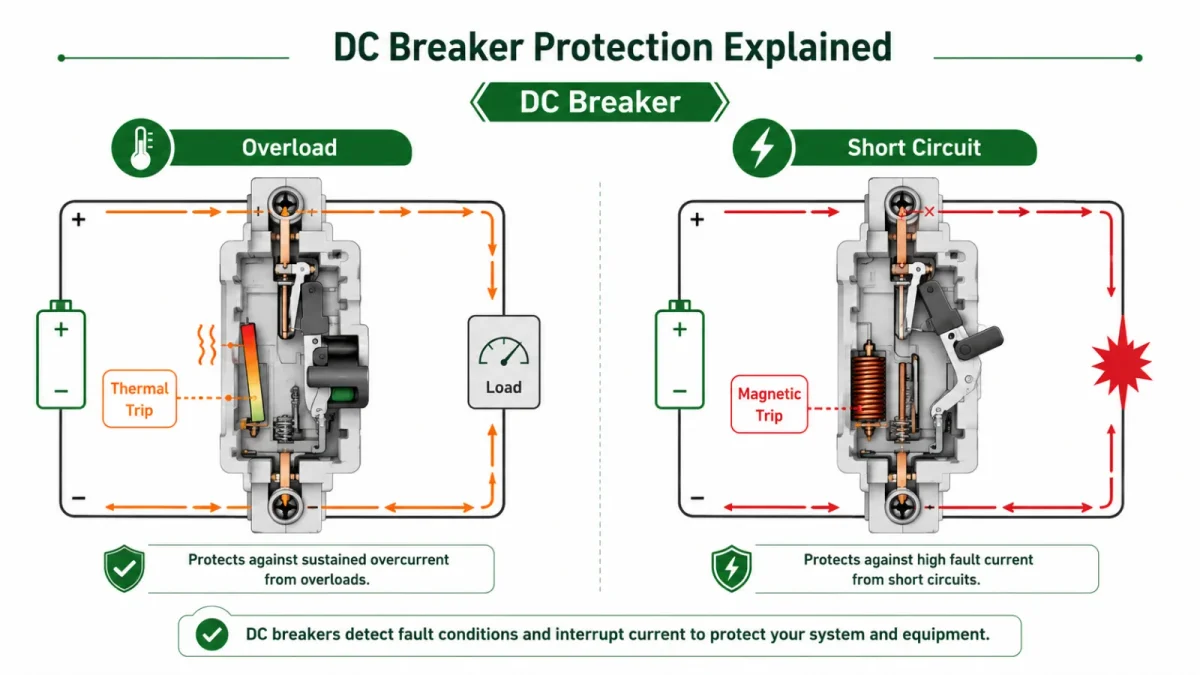
A DC MCB mainly protects the circuit against two types of faults:
| Protection Type | Function |
|---|---|
| Overload Protection | When the current exceeds the rated current for a long period, the thermal trip mechanism disconnects the circuit. |
| Short Circuit Protection | When a high fault current occurs, the magnetic trip mechanism disconnects the circuit quickly. |
For solar PV strings, battery systems and DC distribution applications, both overload and short-circuit protection are important. The breaker should be selected according to the normal operating current, possible fault current and cable capacity.
---
3. Understanding Trip Curves
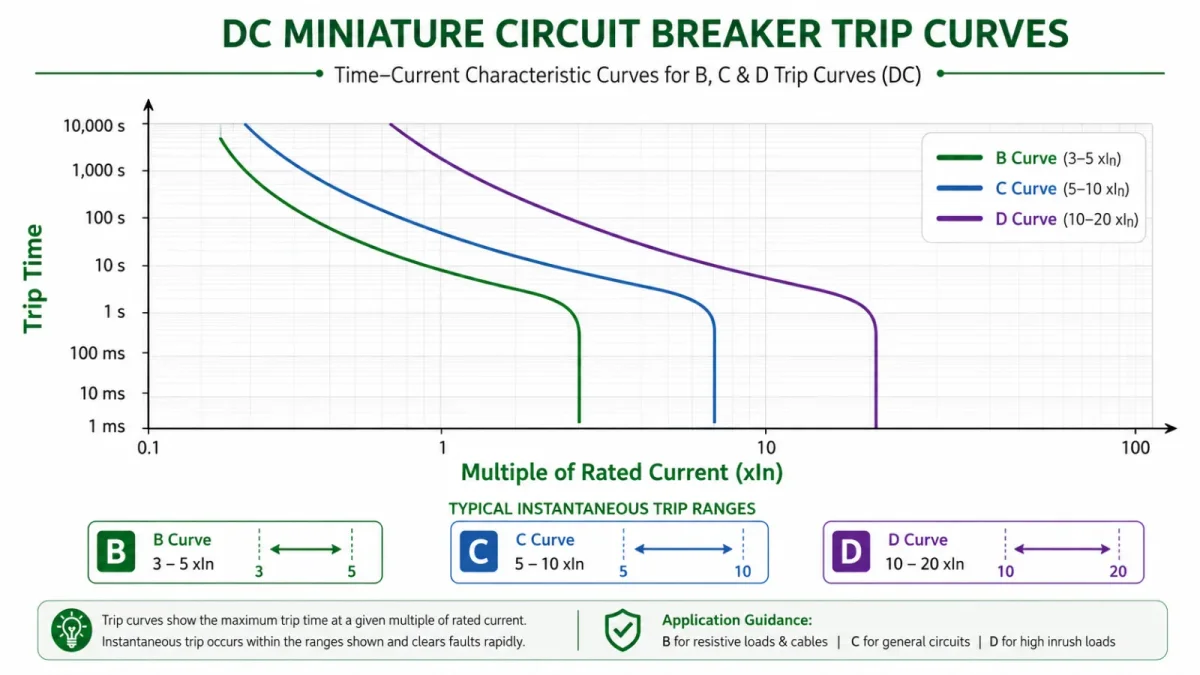
The trip curve defines how quickly the breaker trips under different current levels. Common DC MCB trip curves include B, C and D.
| Trip Curve | Instantaneous Trip Range | Typical Application |
|---|---|---|
| B Curve | 3–5 × In | Resistive loads and circuits with low inrush current. |
| C Curve | 5–10 × In | General DC distribution, solar PV systems, control cabinets and battery storage systems. |
| D Curve | 10–20 × In | Loads with high inrush current, such as motors or inductive equipment. |
For many solar PV and battery storage applications, C Curve is commonly used because it provides a balanced response for general DC protection.
For example, a C63 DC MCB means the rated current is 63A and the breaker follows a C trip curve. Its instantaneous trip range is approximately:
63A × 5 to 63A × 10 = 315A to 630A
This means the breaker may trip instantly when the current reaches roughly 315A to 630A, depending on the product design and test conditions.
---
4. DC Voltage and Pole Configuration
For DC circuit breakers, voltage and pole configuration are especially important. A DC breaker cannot be selected by current rating alone.
| Pole Configuration | Common Rated Voltage | Description |
|---|---|---|
| 1P | DC 250V / 500V | Single-pole interruption, suitable for lower DC voltage circuits. |
| 2P | DC 500V / 1000V | Commonly used in solar PV and battery energy storage systems. |
| 3P | DC 750V / 1000V / 1200V | Used in some higher-voltage DC systems. |
| 4P | DC 1000V / 1500V | Commonly used in PV combiner boxes and inverter input protection. |
In high-voltage DC systems, multiple poles are often connected in series to improve arc interruption capability. For example, a DC 1000V or DC 1500V system usually requires a multi-pole DC MCB instead of a simple 1P breaker.
Do not use an AC circuit breaker or a low-voltage DC breaker in a high-voltage DC system. DC arcs are more difficult to extinguish than AC arcs, so the breaker must be designed and rated specifically for the DC voltage of the system.
---
5. Mechanical and Installation Requirements
After confirming the electrical parameters, the next step is to check mechanical and installation requirements. These details affect wiring, panel layout and long-term reliability.
| Parameter | Common Requirement |
|---|---|
| Mounting | 35mm DIN rail mounting |
| Terminal Type | Top and bottom wiring, copper wire or busbar connection |
| Cable Capacity | 1–25mm², 1–35mm², 1–50mm² |
| Terminal Torque | Typically 2.0–3.5 N·m, depending on the model |
| Mechanical Life | 10,000–20,000 cycles |
| Electrical Life | 1,500–6,000 cycles |
| Protection Degree | Commonly IP20 |
| Ambient Temperature | Typically -25°C to +70°C |
For PV combiner boxes and battery cabinets, make sure the selected DC MCB fits the available DIN rail space and supports the required cable size. The terminal torque should also be followed during installation to avoid overheating caused by loose wiring.
---
6. Materials and Safety Features
A reliable DC circuit breaker should use suitable insulating materials, contact materials and arc-extinguishing structures.
| Parameter | Description |
|---|---|
| Housing Material | Flame-retardant nylon or PA66, commonly UL94 V-0 grade. |
| Contact Material | Silver alloy contacts are preferred for better conductivity and durability. |
| Arc Extinguishing System | A dedicated DC arc-quenching structure is required. |
| Polarity | Some DC MCBs are polarity-sensitive and must be wired correctly. |
| Indicator Window | Red/green window for ON/OFF status indication. |
| Isolation Function | Some models can also be used as isolation switches. |
Polarity is a key detail. Some DC breakers have marked positive and negative terminals, and incorrect wiring may reduce arc-extinguishing performance. Always follow the wiring diagram printed on the product or included in the datasheet.
---
7. Common Standards for DC Circuit Breakers
When selecting a DC MCB for international projects, standards are important for compliance, safety and customer acceptance.
| Standard | Application |
|---|---|
| IEC 60947-2 | Low-voltage circuit breakers for industrial applications. |
| IEC 60898-2 | Circuit breakers for household and similar installations, including AC and DC applications. |
| EN 60947-2 | European standard for industrial low-voltage circuit breakers. |
| UL 489B | DC photovoltaic circuit breakers, commonly required in the US market. |
| IEC 60269 / IEC 60364 | Related to fuse protection and low-voltage electrical installations. |
For solar PV systems, battery energy storage systems and export projects, it is recommended to confirm the required certification or test standard before placing an order.
---
8. Selection Checklist for DC MCBs
Before choosing a DC miniature circuit breaker, confirm the following points:
| Selection Item | What to Check |
|---|---|
| System Type | Solar PV, battery storage, DC distribution, EV charging or control cabinet. |
| System Voltage | DC 250V, 500V, 1000V, 1200V or 1500V. |
| Rated Current | Select according to the normal operating current and cable capacity. |
| Pole Configuration | Choose 1P, 2P, 3P or 4P based on system voltage and wiring design. |
| Breaking Capacity | Confirm the available short-circuit current of the system. |
| Trip Curve | B, C or D curve according to load type and inrush current. |
| Polarity | Check whether the breaker is polarity-sensitive. |
| Installation Method | Confirm DIN rail size, cable size and terminal torque. |
| Standards | IEC, EN or UL requirements depending on market and project. |
---
9. Practical Selection Example
If you are selecting a DC MCB for a solar PV string or battery cabinet, you may need to confirm the following:
A typical selection could be:
C63 DC MCB, 2P, DC 1000V, 6kA / 10kA, DIN rail mounted
However, the final selection should always be based on the system voltage, short-circuit current, wiring method and applicable standard.
---
- System voltage: DC 1000V
- Rated current: 63A
- Number of poles: 2P or 4P depending on wiring design
- Trip curve: C Curve
- Breaking capacity: 6kA or 10kA
- Mounting: 35mm DIN rail
- Application: PV combiner box or battery energy storage system
Conclusion
Choosing the right DC miniature circuit breaker is essential for the safety and reliability of solar PV, battery storage and DC distribution systems. The most important factors are not only the rated current, but also the DC voltage rating, pole configuration, breaking capacity, trip curve, arc-extinguishing capability and applicable standards.
For high-voltage DC systems such as DC 1000V or DC 1500V solar applications, always use a circuit breaker specifically designed for DC interruption. Multi-pole configurations are often required to safely interrupt DC arcs.
If you are not sure which DC MCB is suitable for your project, provide the system voltage, current, application scenario and wiring diagram to the supplier. This will help ensure that the selected breaker meets both safety and performance requirements.
---
Related Products
- [[[DC Miniature Circuit Breakers](/products/category/mcb)]
- [[Solar PV Combiner Box Components](/products/combiner-box)]
- [[DIN Rail Electrical Protection Products](/products/mcb)]
Need Help Selecting a DC MCB?
TPKELE supplies DC miniature circuit breakers for solar PV, battery energy storage, DC distribution and industrial control applications. Contact us with your voltage, current, pole configuration and application requirements, and our team will help you select the right model. DC Miniature Circuit Breakers Request a Quote: Contact TPKELE
Frequently Asked Questions
- Which DC circuit breaker rating do I need for a 300W solar panel?
- For a 300W panel with 36Vmp and 8.3A Isc, use a breaker rated at least 10A (8.3A × 1.25). Choose a 10A DC MCB with a breaking capacity suitable for your system voltage.
- How many amps of DC circuit breaker for a 48V battery bank?
- Calculate based on inverter or load current. For a 3000W inverter at 48V, continuous current is 62.5A. Use a 80A breaker (62.5A × 1.25). Ensure the breaker is rated for 60V DC minimum.
- Can I use an AC circuit breaker for DC?
- No. AC breakers rely on zero-crossing to extinguish arcs; DC arcs are continuous. Using an AC breaker on DC can cause arc persistence and fire. Always use a DC-rated circuit breaker.
Related Articles
References & Resources
- IEC 60947-2 standard
Official standard for DC circuit breaker breaking capacity and performance requirements.
- NEC 690.8 overcurrent protection
National Electrical Code article for sizing DC overcurrent protection in PV systems.
- DC Miniature Circuit Breakers