Why Metering Matters in Modern Distribution
Sub-metering is no longer optional in commercial real estate, manufacturing and multi-tenant facilities. Tenants expect transparent cost allocation, and operations teams need consumption data to identify waste and verify equipment efficiency.
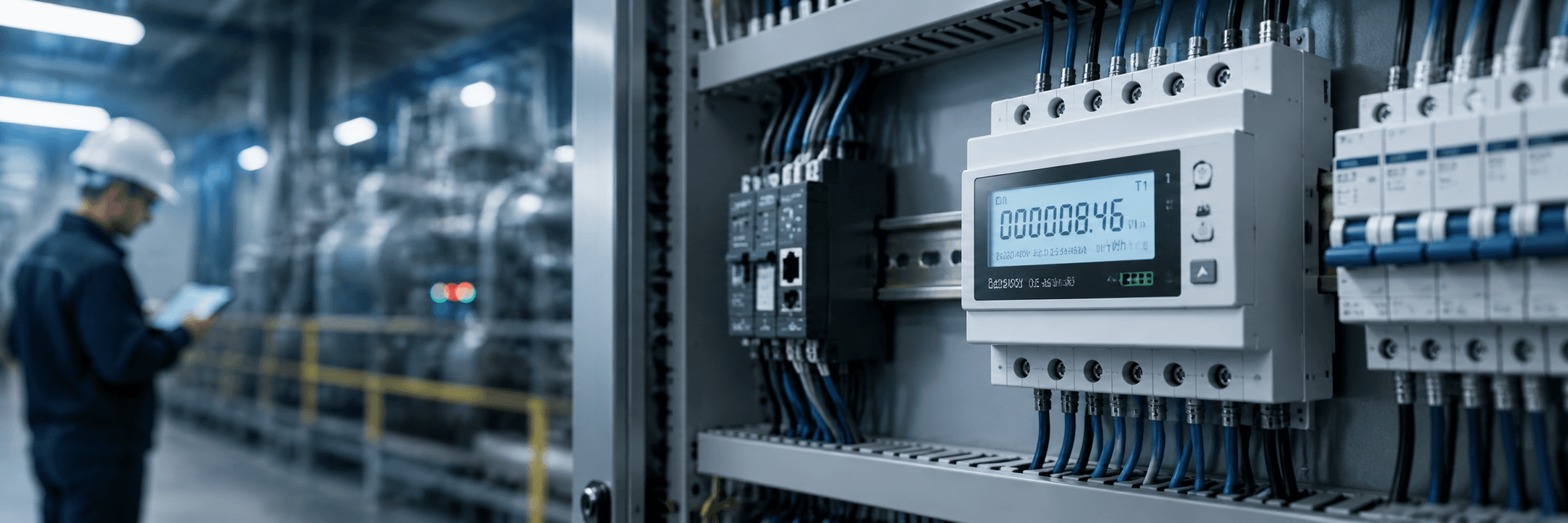
A modern DIN-rail energy meter replaces costly mechanical meters with compact, accurate electronic units that measure active energy, current, voltage, power factor and frequency in a 1 or 4-module form factor.
Single-Phase vs Three-Phase
Use a single-phase meter for residential apartments, retail tenant sub-metering and lighting circuits. Use a three-phase meter for HVAC plants, motor feeders, EV chargers and industrial process equipment. Always confirm the system topology — three-phase three-wire versus three-phase four-wire (with neutral) — affects meter wiring and accuracy.
Direct Connect vs CT Connect
Direct-connect meters wire the load current straight through the meter, typically up to 80A or 100A. Above that current, use a CT-connect meter with current transformers — this lets a small meter measure feeders rated 200A, 400A or higher without huge conductors crossing the meter terminals.
Accuracy Class
IEC 62052-11 specifies accuracy classes 0.5S, 1 and 2. Class 1 is adequate for cost-allocation sub-metering. Class 0.5S is required for revenue-grade and utility tariff metering, and worth the modest premium when the data is used for billing.
Communication Options
- Modbus RTU (RS-485) — most common; integrates with BMS, PLCs and energy dashboards.
- Pulse output — simple kWh pulse that any logger can count.
- MID approval — required in EU member states for sub-tenant billing.
- M-Bus, KNX or LoRa — niche options for specific BMS or smart-building protocols.