DC MCB Selection Guide for Solar PV Systems
Complete technical guide for selecting DC miniature circuit breakers in solar photovoltaic applications.
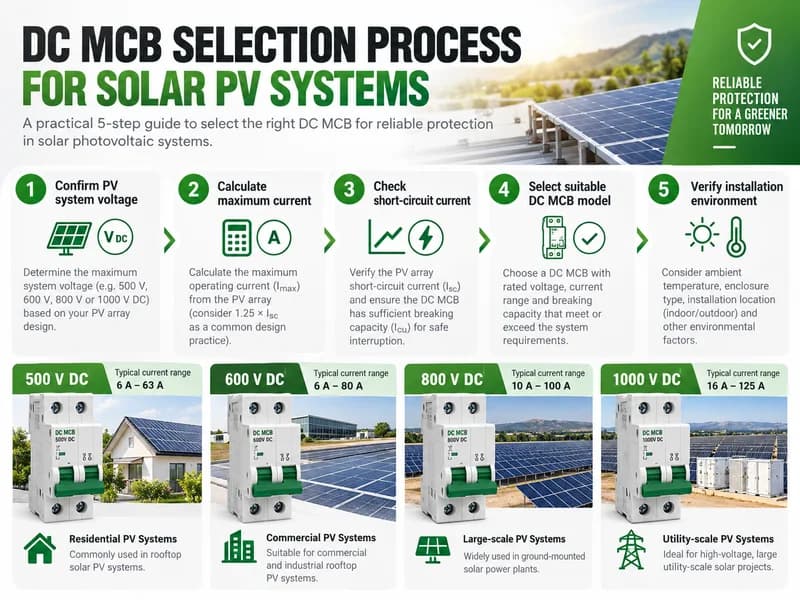
1. Selection Overview
DC miniature circuit breakers (MCBs) are essential protection devices in solar PV systems. Unlike AC applications, DC circuits present unique challenges including arc suppression difficulties and the need for specialized breaking mechanisms.
This guide provides a systematic approach to selecting the correct DC MCB for your solar PV installation, covering voltage ratings, current capacity, breaking capacity, and compliance requirements.
2. Required Technical Inputs
Before selecting a DC MCB, gather the following system parameters:
- System voltage (Voc): Open-circuit voltage of the PV array
- Maximum current (Isc): Short-circuit current of the string
- Operating current: Maximum power point current (Imp)
- Environmental conditions: Temperature range and altitude
- Installation location: Indoor/outdoor and accessibility
3. Key Selection Parameters
1. Rated Voltage (Un)
The DC MCB rated voltage must exceed the maximum open-circuit voltage (Voc) of the PV string under all conditions, including cold weather when Voc increases.
2. Rated Current (In)
Select a rating between 1.25× and 1.56× the maximum operating current to prevent nuisance tripping while providing adequate protection.
3. Breaking Capacity (Icu/Icn)
Must exceed the maximum fault current available at the installation point, typically 1.25× Isc for solar applications.
4. Voltage Selection
Standard DC voltage ratings:
| Rating | Typical Application |
|---|---|
| DC 500V | Residential PV systems (<15 modules/string) |
| DC 1000V | Commercial PV systems (standard) |
| DC 1500V | Utility-scale PV installations |
Important: Always verify Voc at minimum operating temperature. For example, a 450W module rated at 49V Voc can reach 58V at -25°C.
5. Current Rating Selection
Calculation method:
- Determine string Imp (maximum power current)
- Apply safety factor: In ≥ 1.25 × Imp
- Select next standard rating up
Example:
- Module Imp: 11.5A
- Minimum rating: 1.25 × 11.5A = 14.4A
- Selected rating: 16A or 20A (standard)
Standard DC MCB current ratings: 6A, 10A, 16A, 20A, 25A, 32A, 40A, 50A, 63A
6. Breaking Capacity
Breaking capacity (Icu or Icn) is the maximum fault current the MCB can safely interrupt.
Solar PV Fault Current Calculation
Maximum fault current ≈ 1.25 × Isc × number of parallel strings
Standard Breaking Capacities
- 3kA: Single-string residential systems
- 6kA: Multi-string residential (2-4 strings)
- 10kA: Commercial installations (5-10 strings)
- 15kA+: Large commercial/utility systems
7. Solar PV Application Example
Scenario: 10kW Residential Rooftop System
System specifications:
- Module: 450W, Voc 49V, Isc 11.8A, Imp 11.5A
- Configuration: 2 strings, 11 modules per string
- System Voc: 11 × 49V = 539V
- String Isc: 11.8A
Selection process:
- Voltage: Voc = 539V → Select DC 1000V rated MCB
- Current: 1.25 × 11.5A = 14.4A → Select 16A rating
- Breaking capacity: 1.25 × 11.8A × 2 strings = 29.5A → 6kA is sufficient
Result: DC MCB 2P, 16A, 1000V, 6kA, curve C
8. Standards Reference
International Standards
- IEC 60947-2: Low-voltage switchgear and controlgear - Circuit breakers
- IEC 60364-7-712: Electrical installations of buildings - Solar photovoltaic systems
Compliance Documentation
DC MCBs for international projects require conformity documentation appropriate to the destination market. Requirements vary by product scope, voltage class, application and country-specific regulations.
→ For verified market-specific requirements, use the Market Access Advisor
9. Market Access Requirements
Compliance requirements for DC MCBs vary significantly by product scope, voltage rating, breaking capacity, intended use and destination country. Specific certification needs depend on whether the product is classified as industrial switchgear, household protection or PV-specific equipment.
Common Regulatory Frameworks
- IEC-based approval systems (Europe, Middle East, Asia-Pacific)
- UL/CSA listing requirements (North America)
- National certification schemes (CCC, SASO, ESMA, etc.)
Important: Do not assume certification requirements based on product category alone. Market access rules are product-scope-dependent and change frequently.
→ Check verified, current requirements in the Market Access Advisor
10. Frequently Asked Questions
Can I use an AC MCB for DC applications?
No. AC MCBs are not designed for DC arc interruption. DC arcs do not have zero-crossing points, making them significantly harder to extinguish. Always use DC-rated circuit breakers.
What is the difference between 1-pole and 2-pole DC MCBs?
For grounded PV systems, 2-pole MCBs provide positive and negative pole protection. For floating/ungrounded systems, both poles must be switched. Check local codes - most require 2-pole protection.
Do I need an MCB on both string inputs to the combiner box?
Yes, each string should have individual overcurrent protection. This allows isolation of individual strings for maintenance and provides string-level fault protection.
What is the correct trip curve for solar applications?
Curve C is standard for most PV applications. It provides appropriate inrush tolerance while responding quickly to short circuits.
How does temperature affect DC MCB performance?
Ambient temperature affects the thermal trip point. MCBs are typically rated at 30°C. In hot climates (40°C+), consider derating or selecting the next size up to prevent nuisance tripping.
Need market-specific export guidance?
Use the TPKELE Market Access Advisor to review likely standards, document expectations and buyer-facing market information for the selected product and application.