
TPKELE · ATS Производство
ATS Manufacturer in China for OEM Automatic Transfer Switch Supply
TPKELE produces automatic transfer switches for distributors, panel builders and critical-power project buyers who need fast, reliable changeover between mains and backup with full documentation and consistent OEM packaging.
What serious buyers usually check first
- Whether the changeover time is confirmed
Transfer time affects how long the load sees a voltage interruption. PC-class ATS and CB-class units have different transfer profiles — confirm which applies.
- Whether the neutral overlap or break-before-make is appropriate
Some loads require neutral continuity during transfer; others require a clear break. The ATS design must match the load type.
- Whether the voltage sensing window is adjustable
Under-voltage and over-voltage thresholds that can be set on site reduce commissioning calls and avoid nuisance transfers.
- Whether the certificate covers the exact pole count and rating
IEC documentation must match the 2P, 3P or 4P configuration and current rating on your purchase order.
- Whether the enclosure and terminal layout suit the panel
DIN rail fit, terminal torque and busbar spacing need to match the enclosure the ATS will be installed in.
Почему это важно
Why a dedicated ATS manufacturer is different from a generic trader
An automatic transfer switch is an electromechanical device that operates under fault conditions. Its reliability depends on the actuator mechanism, contact design and control circuit — all of which need to be consistent across production batches, not just on the sample.
Consistent mechanical performance
Contact mechanism, actuator spring force and transfer timing are held to the same tolerance across batches because they are calibrated on the production line, not just on the approval sample.
Control circuit matched to the mechanism
Voltage sensing thresholds, time delays and manual override are designed around the specific actuator rather than added as an aftermarket control board.
Documentation for critical-power applications
Panel builders and EPC contractors who install ATS in hospitals, data centres or telecoms sites need test reports and certificates that match what is installed, not a generic approval.
Производитель или посредник
Manufacturer vs trader — what changes for the ATS buyer
| What a dedicated manufacturer gives you | What usually happens with a generic trader |
|---|---|
| ✔Actuator mechanism and control circuit from the same engineering team | ✗Mechanical and control sourced separately and assembled without matched calibration |
| ✔Transfer time verified per production batch | ✗Transfer time stated on datasheet but not tested per batch |
| ✔IEC 60947-6-1 documentation for the exact pole count and rating | ✗Certificate covers the family; the specific configuration may not be tested |
| ✔Voltage sensing thresholds documented and adjustable range confirmed | ✗Threshold range described verbally, not documented in the test report |
| ✔OEM branding and panel cutout dimensions held stable | ✗Mechanical dimensions change between production runs without notification |
| ✔Batch traceability so a field failure can be investigated | ✗No batch information available after goods have shipped |
Ассортимент продукции
ATS product families by class and pole configuration
TPKELE offers PC-class and CB-class automatic transfer switch families for different low-voltage power transfer applications. Select a product family first, then confirm the required pole configuration, rated current, neutral switching method and project requirements.
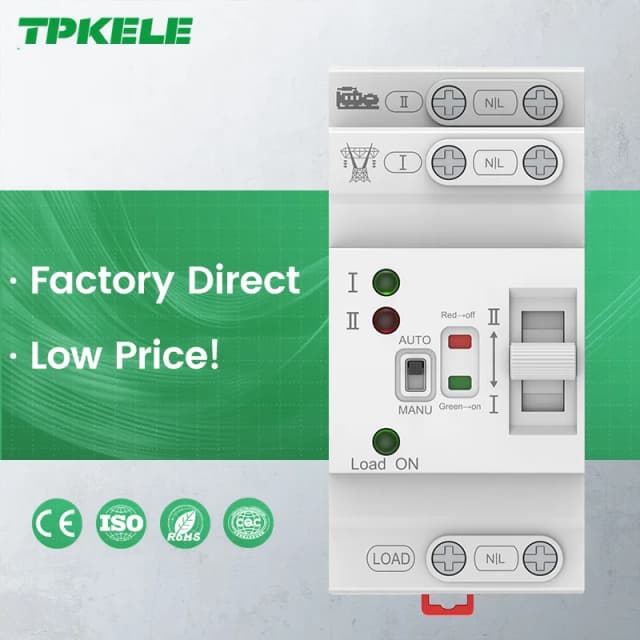
Compact PC-class automatic transfer switches for applications requiring fast source transfer.
View ATS-ST Series →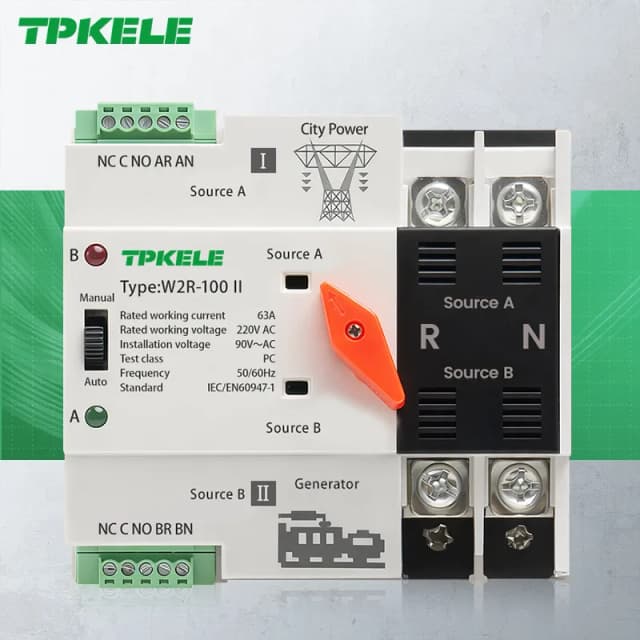
PC-class ATS family with multiple pole configurations for single-phase and three-phase systems.
View ATS-W2R Series →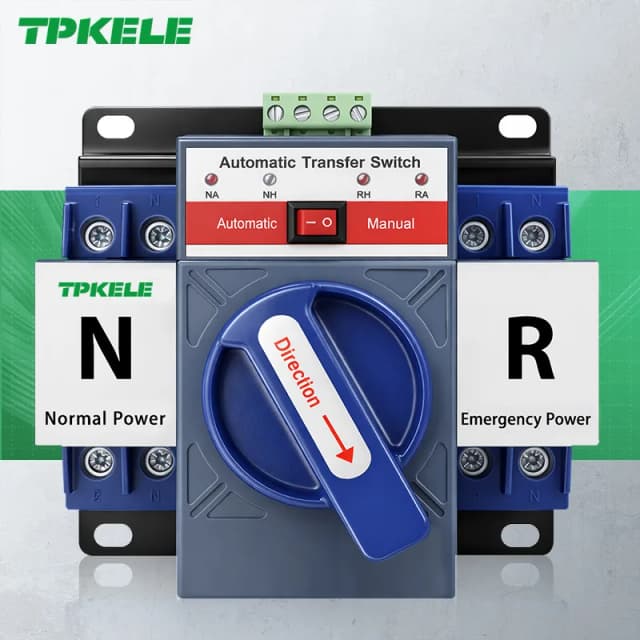
CB-class motorized automatic transfer switches for low-voltage distribution applications.
View STQ1 Series →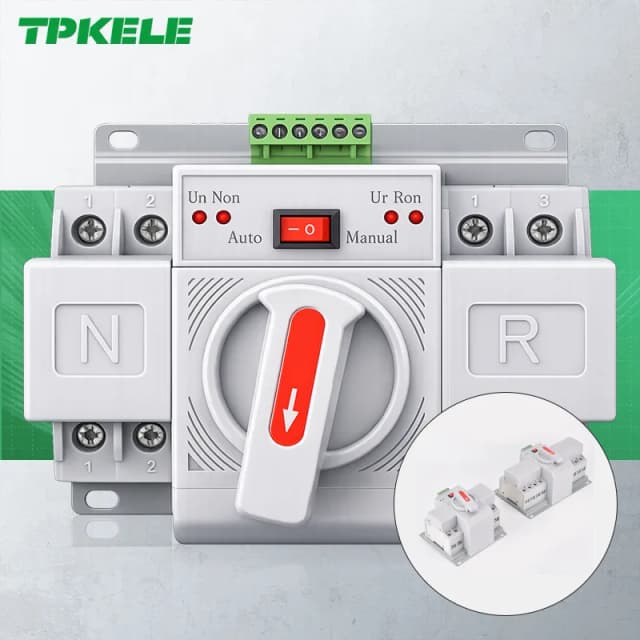
CB-class automatic transfer switch family with multiple pole configurations for power distribution systems.
View STQ2 Series →ПримечаниеNote: PC-class and CB-class ATS products have different operating characteristics and application requirements. Confirm the ATS class, pole count, rated current, system voltage and neutral switching requirements before requesting a sample or quotation.
Требования покупателей
What export buyers usually need from an ATS factory
ATS is installed in critical-power applications where a changeover failure is a site incident. Buyers who work in these markets need documentation and testing that reflects actual production, not just the engineering sample.
Product consistency
- Actuator mechanism and spring force held constant across batches
- Transfer time verified per lot
- Voltage sensing thresholds stable across production runs
- Terminal torque and DIN rail fit unchanged
- Batch code printed and traceable
Certification clarity
- IEC 60947-6-1 for the exact class, pole count and rated current
- Test report available in full
- CE declaration for the shipped configuration
- Neutral handling behaviour documented
- RoHS declarations for the shipped build
OEM and branding
- Logo on housing face and front panel
- Custom label and packaging language
- Panel cutout dimensions confirmed before artwork
- Artwork proof before production
- Consistent marking across repeat orders
Commercial predictability
- Lead time quoted for sample and mass order
- Pricing by pole count and class
- Repeat order price held for an agreed window
- Shipping carton dimensions confirmed early
- Written policy on batch review
Процесс OEM
OEM automatic transfer switch workflow for branded supply
ATS OEM work follows the same staged sign-off as any electromechanical component, with an additional step to confirm the control circuit settings for the application.
01 · Confirm class and configuration
PC or CB class, pole count, rated current, neutral overlap or break-before-make — fixed in writing.
02 · Approve sample and transfer test
Sample produced on production tooling; transfer time and voltage threshold data attached to the sample record.
03 · Lock the branding
Logo, label, panel cutout drawing and carton marking proofed as files.
04 · Set the inspection rule
Transfer time check, contact resistance and acceptance limits agreed before the run.
05 · Release and document
Batch codes assigned; IEC certificate and test report issued against the shipped configuration.
06 · Maintain across repeat orders
Same actuator specification and artwork revision so later orders match the first.
Завод и качество
Factory capability, quality control, and documentation for ATS supply
ATS reliability is set during calibration, not at final inspection. Actuator spring force and control circuit thresholds need to be verified during assembly, not only on a sample at the end of the line.
Factory and production capability
- Actuator assembly and calibration in-house
- Control circuit matched to the mechanical design
- PC-class and CB-class on shared documentation platform
- Volume capacity for repeat project orders
- Component lot traceability from intake to finished goods
Quality control and testing workflow
- Incoming inspection on actuators and contacts
- Transfer time verification per lot
- Voltage sensing threshold check
- Insulation resistance and dielectric test
- Mechanical endurance sampling
- Pre-shipment sampling against approved acceptance rule
Документация
Documentation, sample handling, and repeat-order control for ATS buyers
Critical-power applications require documentation that can be presented to a building inspector or an EPC engineer. Confirm the document set before production, not on delivery.
| What to request | Why it matters to the buyer |
|---|---|
| IEC 60947-6-1 test report for the shipped class and rating | Required for project submission in most critical-power applications |
| Certificate naming exact class, poles and current | Prevents a mismatch between the document and the goods |
| Sample record with transfer time data | Reference if a later batch shows different changeover behaviour |
| Control circuit threshold documentation | Allows the buyer to set voltage windows correctly on site |
| Artwork revision number on file | Stops label and marking drift between orders |
| Inspection and acceptance rule in writing | Turns pre-shipment checking into a defined pass or fail |
Стандарты и сертификаты
How a reliable ATS manufacturer should talk about standards
ATS applications in critical infrastructure are subject to project specifications that reference specific IEC clauses. A manufacturer who can answer questions at that level of detail is working from test data, not from a datasheet.
| Standard or document | What it should cover |
|---|---|
| IEC 60947-6-1 | Low voltage switchgear — transfer switching equipment, covering PC and CB class |
| CE marking | Declaration with test evidence for the class, pole count and rated current supplied |
| RoHS / REACH | Material compliance for the shipped build |
| Neutral handling documentation | Overlap or break-before-make behaviour stated and tested |
| Factory quality system | Process control linking calibration records to batch codes |
| Test report traceability | Report references the class, poles and rating on your order |
Коммерческие условия
Commercial points to align before ATS sample or quotation
ATS projects tend to have tighter delivery windows than commodity components. Getting the technical scope and documentation requirements on file early avoids last-minute delays.
| Point to align | What to put in writing |
|---|---|
| Class and configuration | PC or CB class, pole count, rated current, neutral handling |
| Voltage sensing range | Threshold adjustability range and default factory settings |
| Sample terms | Lead time, cost treatment and whether sample binds mass production |
| Lead time | Separate figures for sample and mass order |
| Packaging | Individual box or bulk, language, carton marking |
| Inspection | Transfer time check, contact resistance and acceptance limit |
| After-sales handling | How a batch review is raised and what replacement path applies |
Частые вопросы
ATS manufacturing questions buyers ask most
What is the difference between PC-class and CB-class ATS?
PC-class (power controller class) ATS uses a dedicated switching mechanism designed specifically for transfer — it cannot interrupt fault current independently. CB-class uses two coordinated circuit breakers with a motorised interlock and can interrupt fault current. PC-class is faster; CB-class offers higher interrupting capacity. Both are available from TPKELE.
Does the ATS handle neutral before live conductors during transfer?
This depends on the configuration. Break-before-make prevents any parallel path between sources; overlap maintains neutral continuity during transfer for sensitive loads. The neutral handling behaviour is documented in the product specification and should be confirmed for the application before ordering.
Can voltage sensing thresholds be adjusted on site?
Yes. The under-voltage and over-voltage trip windows are adjustable within a defined range, which is documented in the product datasheet. Default factory settings are stated and can be confirmed at the sample stage.
What documentation is available for project submission?
IEC 60947-6-1 test report for the shipped class and rated current, CE declaration, and the approved sample record. The neutral handling behaviour is documented separately and available on request.
Is OEM branding available?
Yes. Logo on the housing, custom label and packaging language, and carton marking are all handled as normal OEM work. Artwork is proofed before the production run is released.
What is the typical lead time?
Sample and mass production lead times are quoted separately. The exact figure depends on pole count and class mix; repeat orders are faster because the technical scope is already on file.
Поставка ATS · Расчёт за 72 часа